Cpl. John Geter
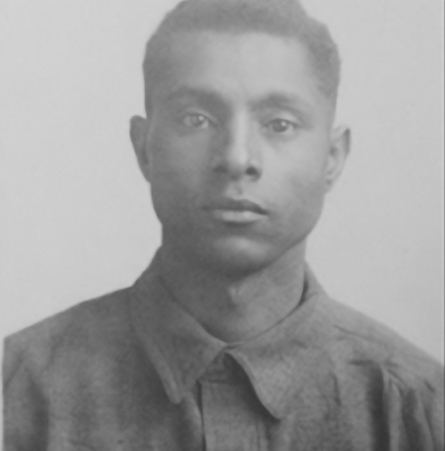
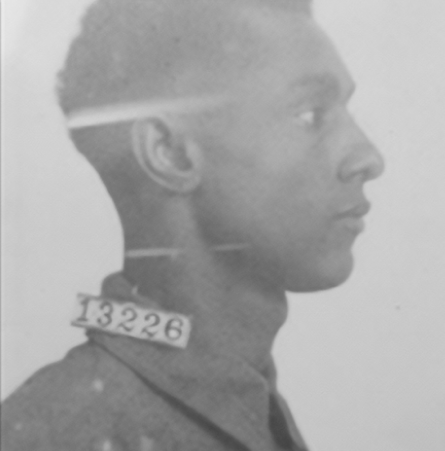
John Geter was born in 1892 in Columbia Co. Georgia; he left school at 16 after completing the fourth grade. He enlisted November 1912 into I Co, 3/24 Infantry. His personnel record indicated that before the army he had worked on a farm with his father and he was described as “industrious and a total abstainer.” He had no record of any previous trouble with the law.
Geter was one of the men tried in U.S. v Tillman and was convicted on all charges. His sentence, as rendered in General Court-martial Order of September 7, 1918, was originally death by hanging, but his was one of the death sentences commuted by President Wilson on Secretary Baker’s recommendation. The reasons for his original sentence may have had to do with the fact that he was a noncommissioned officer and was allegedly one of the agitators before the mutiny broke out; the review of his case states that he “was in the company street agitating at 3:00 P.M. saying that the men should go down and shoot up the town and kill the policeman who assaulted Corporal Baltimore; that he was at the meeting of noncommissioned officers in the afternoon discussing the Baltimore affair… that he was one of the men who made the rush on the Supply tent to get ammunition… that he was not seen in camp by witnesses present shortly after firing stopped.” He was alleged to be one of the group of men who fired on the ambulance that approached the camp shortly after the shooting in camp; “accused identified by civilian witness as resembling the man who stopped his ambulance that night.” He was accused of then joining Sergeant Henry’s column as it crossed the officer’s line and that he was armed and wearing an ammunition bandolier at that time.
Unlike most of the other defendants, Geter took the stand on his own behalf and testified under oath. He was 29 years old at the time of the riot and had five years, five months of service in the army. He denied being in the noncommissioned officer huddle as was claimed by prosecution witnesses; he denied participating in the ammunition grab; he said he secured a rifle and bandolier after the Henry column formed but did not join the column. He admitted to being at the scene of the ambulance with other soldiers but claimed he did not fire on it, and was only there to try and get it out of the ditch. (This was corroborated by several witnesses and later admitted by the JAG.)
Evaluation during his incarceration at Leavenworth listed him as physically unfit for service because of “chronic bronchitis;” morally unfit “Solely by reason of the crime for which he is now serving sentence,” which was the standard wording on all inmates’ evaluations. The same evaluation concluded “This man has an excellent civil and military record. Reported an asset according to his company commander and recommended highly by Maj. E. J. Carr I.G.D. His physical condition is not likely to improve under confinement.”
When his case was reviewed in April 1920 the board concluded that after interviewing him, it had “elicited nothing additional to the evidence presented in the Court Martial, tending to disprove the charges against him.” The board recommended that “no action in the nature of clemency should be taken in this case at this time.” However, when the case went to the JAG for review two years later (by COL Hull, the prosecutor for the first two courts-martial stemming from the Houston Incident), the reviewer concluded that Geter probably never left the camp that night and was wrongly accused of participation in the violence.