Pvt. James Gaffney
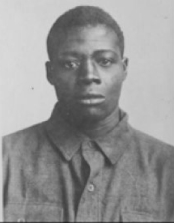
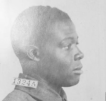
James Gaffney was born in 1896 in North Carolina. He had two arrests on his civilian record from 1910, both for fighting. Prison records indicate he left school at the age of 14 when he was in the fifth grade; a later document in 1924 says that Gaffney himself said he “reached the seventh grade in school,” but all other details match. His prison evaluation claims that a previous employer described him as “rather boastful and stuck on himself… considered rather feeble-minded.” He enlisted in the army in October 1914 and had no negative reports on his service record until the trouble in Houston.
During his incarceration at Leavenworth, the prison evaluation board wrote: “This man has a good military record up to the time of his crime and except for the crime, the Board sees no reason why he should not make a good soldier.” The evaluation concludes, “He states he is not guilty. His company commander states he was a very good soldier and an asset to his organization. Has a good record in the U.S. Penitentiary.”
A first review for clemency in his case was processed on September 5, 1919, and was denied, as was a section review on April 11, 1921. The 1921 review was accompanied by an endorsement from Congressman A. L. Bulwinkle and a personal letter that Gaffney himself had written asking for the Congressman’s help.
In that letter Gaffney wrote: “In view of the fact that there was no evidence against me, I do not quite realize upon what grounds I was convicted. I was eighteen years of age when I enlisted in the army. Private Phiffer of Co. I and Private William S. Kanie [Kane] of Co. I of the 24th Infantry, were witnesses against me. While I had testimony in my favor given by Private McCauler and Cook Harris of Co. L. If you can find it in your power to do so I would like very much if you would review my case and restore me to duty. I have a widowed mother who is not very well and is bed-ridden almost half of the time with Rheumatism and has no one to look after her. She is practically unable to work. And the only one she has to look to is myself.”
In Gaffney’s case, one document disapproving his clemency request says, “The facts discussed in his application were for the court to determine, and it cannot be said that the court erred.” It was a phrase repeated in several other prisoners’ clemency appeals.
A subsequent review for clemency for Gaffney was rejected on July 5, 1922. In November 1923, Congressman Thomas S. Butler (PA) wrote on behalf of Gaffney to the Inspector General at the War Department: “There are living in West Quarter here, a number of colored people related to a former soldier by the name of James Gaffney, a member of Co. K, 24th Inf., who was one of the men charged with being implicated in the Riot at Houston, Texas… He insists that the judgment of the Court is not based upon the facts that would warrant his conviction and that he was not present when these riots occurred. His relatives are extremely
anxious to have the record examined to see whether a mistake could have been made and if so, to present to the President of the United States, a formal application for his pardon.”
Gaffney was twice given the option of testifying on his own behalf at the court-martial, but declined to do so both times. A handwritten note from the JAG office in December 1923 says, “2 sergeants have told Col. Hull that Gaffney was a pretty good soldier.” Gaffney’s sentence was remitted to 22-years and six months in 1924.